


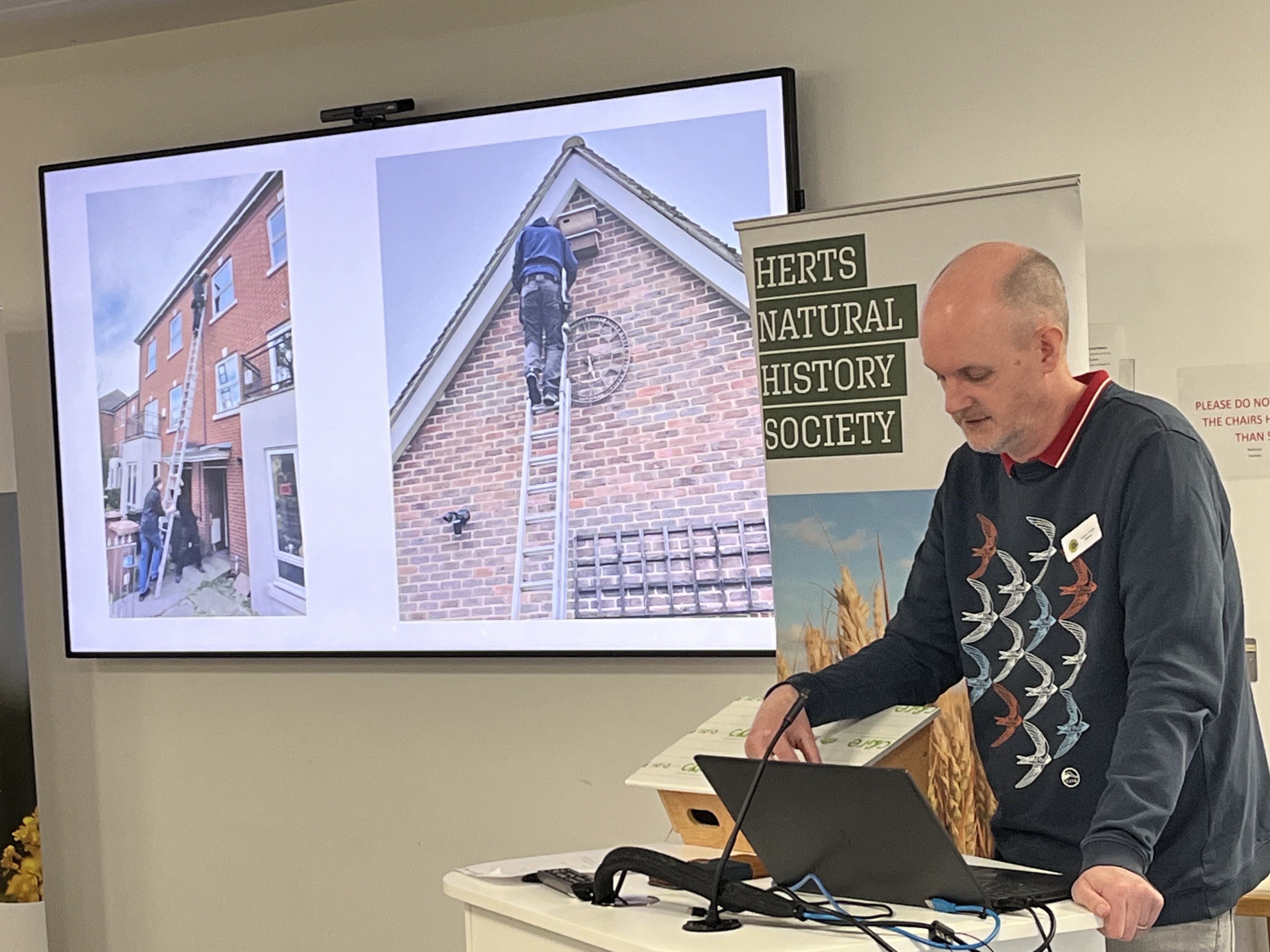
The 2026 Hertfordshire Bird Conference attracted a full house of HNHS/Bird Club members and friends on Saturday 7 March to hear fascinating talks on Swift conservation, birds in urban greenspaces and the 'journey' of a bird record submitted through the Bird Club website.
Videos of all the main presentations can be found on the HNHS YouTube channel
Swifts are our fastest bird in level flight and famously only land when nesting. They otherwise feed, drink, sleep and mate on the wing.
As keynote speaker Graham Knight explained, satellite tracking data has also revealed how their annual migration follows an remarkable series of loops and double-backs as they travel though southern Europe and Africa.
In Britain, surveys suggest the nesting population of Swifts has declined to 35 per cent of its 1995 level and it is 'Red-listed' for special conservation concern. The decline has been attributed to a loss of nesting sites – often a result modern home insulation – more extreme weather events and a decline in insects.
Graham focused his talk on positive and increasingly successful action being taken in Hertfordshire to create new nesting spaces and protect existing sites. The starting point has been continuing efforts to locate Swift nests, using new and improved survey methods. In 2025 1,081 nests were found, compared with 395 in 2023, reflecting the intensifying search.
Even so, there has been relatively little survey work to date in Watford, Hemel Hempstead and a number of other towns in the south and west of the county. Graham would be glad to hear from anyone in those areas willing to assist with the 2026 survey. His estimate is that there could be between 2,500 and 3,000 pairs of Swifts nesting across Hertfordshire as a whole.
Conservation work includes action to install 'Swift boxes' and 'Swift bricks' as a replacement for sealed-up spaces in walls and roofs where the birds were formerly able to nest. Graham and fellow campaigners have also put pressure on local authorities to make the inclusion of 'Swift bricks' in new-build homes a condition of planning permission. They have also inspected building sites to try to increase the level of developer compliance – currently as low as 47 per cent.
Graham was also the presenter for the annual review of significant Herts. bird sightings during 2025. Subject to acceptance by the National Rarities Committee, these include a Baikal Teal – native to eastern Russia – found among more familiar wildfowl at Wilstone Reservoir. If verified, it will be a Hertfordshire 'first', as will a Lapland Bunting found at Stanborough gravel pits.
A total of 14,747 bird records covering 201 species were submitted by 427 observers from 527 sites. However, the number of species is likely to fall below 200 after further examination by the county rare bird panel.
Other highlights included a Red-necked Grebe early in the year, Black-crowned Night Heron (at Rye Meads reserve), a Temminck's Stint, and a transatlantic Pectoral Sandpiper at Stanborough in the autumn. Winter brought an influx of unusual geese, including Tundra Bean Geese near Tring first seen on Boxing Day.
Sadly, it was the first year that no sightings of Turtle Dove were recorded in Herts. There was also only one record of Tree Sparrow, only four years after the last breeding colony, at Tyttenhanger, became extinct.
 The conference heard from Jess Stokes, organiser of the British Trust for Ornithology (BTO) 's new national survey of birds in urban greenspaces. This will be launched as a 'citizen science' project at the start of April and continue for three months.
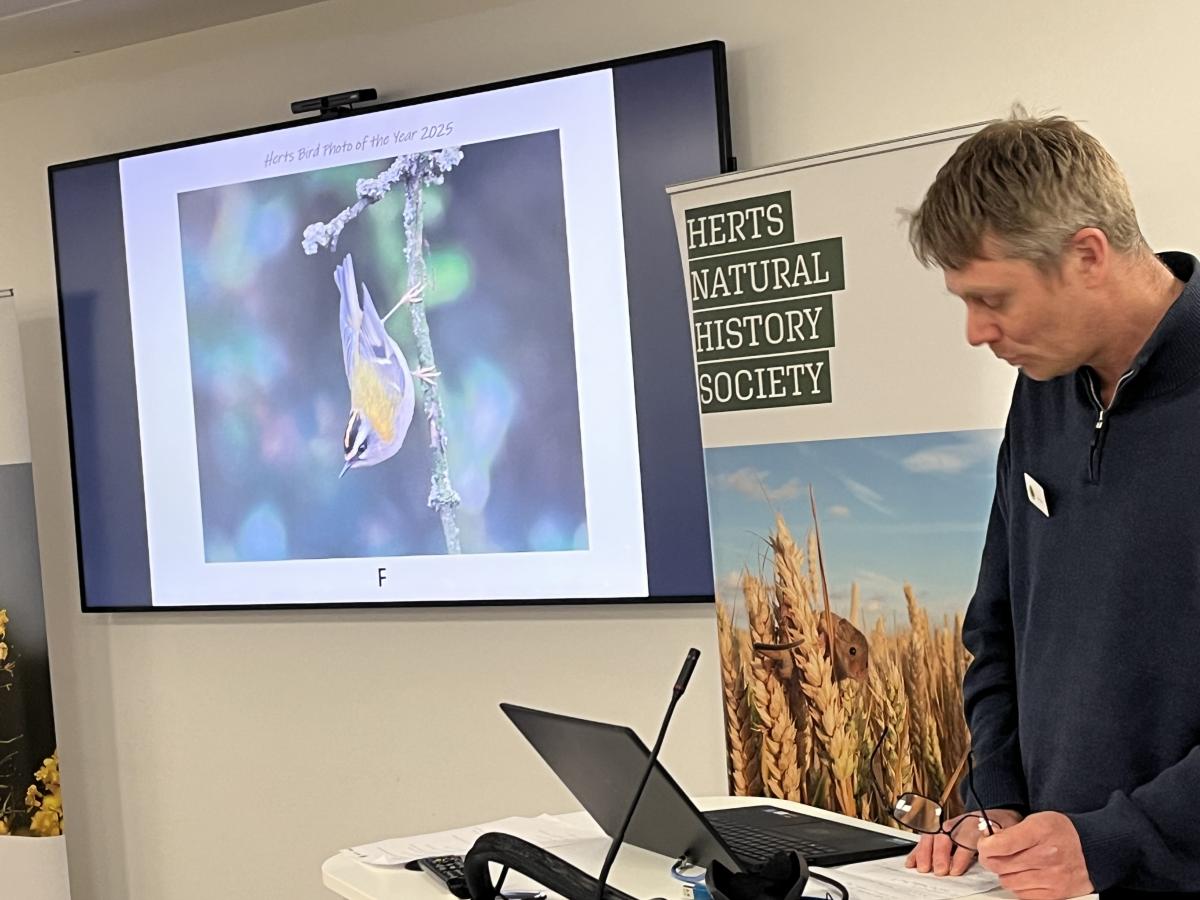
Tom Speller announces the winner of the Herts Bird Photograph of the Year (see below)
The aim is to engage volunteers in discovering the under-studied bird life of parks, playing fields, cemeteries, village greens and other public spaces. The results will be used to create interactive maps and develop management guidance for activities such as grass cutting and the maintenance of boundaries and margins. Those interested in taking part can visit the BTO website to sign-up for 'quick' or more detailed surveys in their area. They will also be able to download a recording app being developed specially for the survey.
The BTO welcomes comments and suggested amendments to its map of greenspaces, which will usually cover up to 75 hectares.
Alex Waechter, Manager of the Hertfordshire Environmental Records Centre (HERC) described the journey taken by a record after it has been submitted through the website. This included verification (organised by the Bird Club ) 'databasing', when records are brought together using specialist software. and analysis to produce valuable information about species populations and other trends. Combined with other information, such as habitat data, the record becomes part of a local and national resource. This can inform planning and other policy decisions as well as conservation action on the ground.
Alex also underlined the added value of observers using the website menu to record breeding information (such as 'singing male') whenever possible to enrich the value of the end-product information.
The conference also heard from Hertfordshire BTO representative Martin Ketcher on the contribution of county birders to the annual Breeding Birds Survey (BBS), the new Winter Birds Survey (WBS) and other national surveys. He noted that a number of survey tetrads are not currently covered and appealed for additional volunteers. Two training sessions have been organised in the coming weeks.
Attendees voted for the Hertfordshire Bird Photograph of the Year. The ten finalists can be viewed on the Bird Club website, including winner Dave Hutchinson's impressive photograph of a Firecrest.
The HNHS and Herts Bird Club are, once again, most grateful to Affinity Water who hosted the conference at their headquarters in Hatfield. Senior Asset Manager Alister Leggatt was able to provide a positive update on Hertfordshire's current water resources, following the persistent rain in January and February.
